The Unseen Revolution in Home Living: Foldable Dining
The tyranny of fixed furniture has long dictated home layouts, often forcing compromises that diminish both function and aesthetic. In the pursuit of maximizing limited square footage, particularly in urban dwellings or multi-functional spaces, the dining area frequently becomes a casualty. We accept cramped corners and the perpetual sacrifice of valuable floor space. But what if the solution wasn’t about *fitting* a dining table in, but about a table that *fits itself* to your life? Foldable dining solutions represent a profound shift in how we conceive of domestic spaces, offering an elegant, practical, and often surprising answer to the perennial challenge of space optimization.
- The Unseen Revolution in Home Living: Foldable Dining
- The Case for Compact: Why Foldable Dining is Essential
- The Many Faces of Foldable Dining: A Spectrum of Ingenuity
- Wall-Mounted Marvels: The Drop-Leaf and Fold-Away
- Freestanding Flexibility: Extendable and Collapsible Tables
- Beyond the Table: Integrated Seating Solutions
- Real-World Applications: Transforming Homes with Foldable Dining
- The Expert’s Blueprint: Selecting and Integrating Foldable Dining
- Beyond Aesthetics: The Psychological and Practical Benefits
- Future Trends: The Evolution of Foldable Dining
- Frequently Asked Questions
- What is the primary advantage of foldable dining furniture?
- Are foldable dining tables stable enough for everyday use?
- What are the different types of foldable dining solutions available?
- How do I choose the right foldable dining table for my home?
- Can foldable dining furniture be stylish as well as functional?
- Final Recommendations: Embrace the Freedom of Foldable Dining
This isn’t about mere convenience; it’s about reclaiming your living environment, infusing it with adaptability, and unlocking its full potential.
The most innovative home solutions don’t add more; they cleverly rearrange what’s already there.
The Case for Compact: Why Foldable Dining is Essential
The modern living landscape, characterized by shrinking apartment sizes and a growing appreciation for minimalist design, demands furniture that is as adaptable as it is attractive. Traditional dining sets, often bulky and immovable, are ill-suited to these evolving needs. Consider the average studio apartment dweller: every square inch is a precious commodity. A permanent dining table can dominate the main living area, rendering it unusable for other activities when not in use for meals. Similarly, in larger homes, a dedicated dining room might sit empty for most of the week, while the kitchen or living room serves as the de facto eating space. Foldable dining furniture offers a powerful antidote to this spatial inefficiency.
It allows for dynamic configuration, transforming a dining area from a dedicated zone to a flexible extension of another room, or even disappearing entirely when not needed. This adaptability is crucial for hosting impromptu gatherings, pursuing hobbies that require open floor space, or simply enjoying a less cluttered visual environment.
Statistics paint a clear picture of this shifting housing paradigm. According to recent reports, the median home size in many developed nations has been steadily decreasing, with newer homes being significantly smaller than those built in previous decades. This trend is mirrored globally. Consequently, homeowners and renters are increasingly seeking furniture that serves multiple purposes and occupies minimal footprint. Foldable dining solutions directly address this need, offering a practical and stylish way to dine without compromising precious living space.
The Many Faces of Foldable Dining: A Spectrum of Ingenuity
The term “foldable dining” encompasses a surprisingly diverse array of designs, each tailored to specific needs and aesthetic preferences. From wall-mounted drop-leaf tables that vanish into the wall to freestanding units with ingenious folding mechanisms, the options are vast. Understanding these variations is key to selecting the perfect solution for your home.
Wall-Mounted Marvels: The Drop-Leaf and Fold-Away
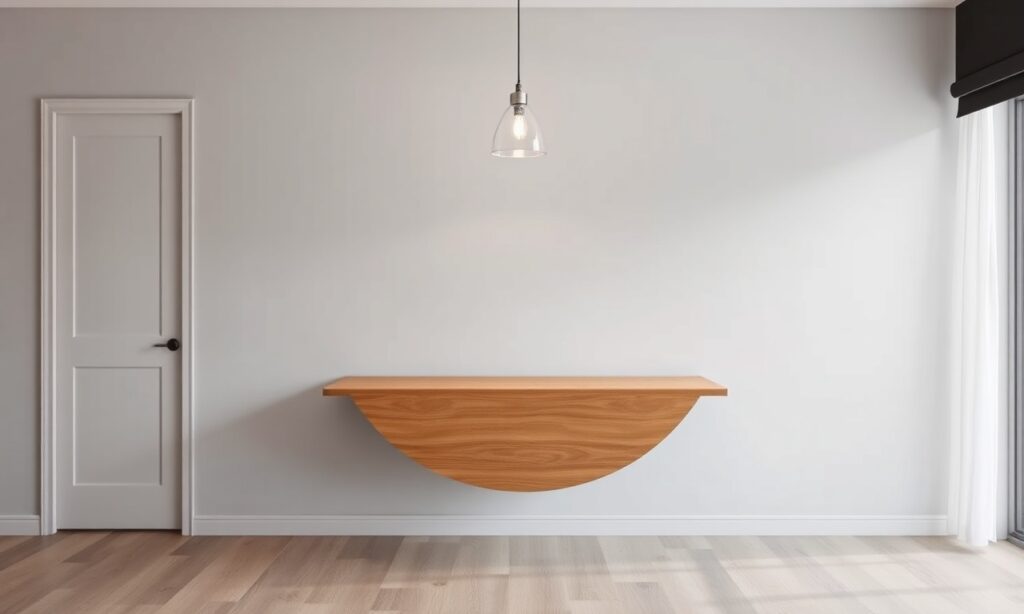
Perhaps the most iconic space-saving dining solution is the wall-mounted drop-leaf table. These ingenious pieces attach securely to a wall, featuring a surface that can be folded down for dining and then folded up against the wall, often with integrated shelving or storage, when not in use. This type of table is ideal for galley kitchens, narrow dining nooks, or any space where floor clearance is paramount. The beauty lies in its discretion; when folded, it becomes an almost invisible part of the room’s architecture.
Another variation is the fold-away dining unit. These are often larger, cabinet-like structures that house a dining table and chairs within them. When closed, they resemble a stylish sideboard or cabinet, but with a simple unfolding mechanism, they reveal a complete dining setup. These are excellent for maximizing utility in a single piece of furniture, offering both storage and a dining solution.
Freestanding Flexibility: Extendable and Collapsible Tables
For those who prefer the flexibility of freestanding furniture, there are numerous foldable dining table designs. Extendable tables are a classic choice, featuring leaves that can be added or removed to adjust the table’s size. While not strictly “foldable” in the sense of disappearing, their ability to shrink to a more compact form makes them highly adaptable.
More akin to the “foldable” concept are freestanding tables with hinged legs or surfaces that collapse. These can be easily stored against a wall, in a closet, or even under a larger piece of furniture when not needed. Some designs are so compact when folded that they can be wheeled away and tucked into tight corners, offering unparalleled convenience.
Beyond the Table: Integrated Seating Solutions
The ingenuity of foldable dining extends beyond just the table itself. Many designs incorporate foldable seating, such as benches or stools that tuck neatly beneath the table or fold away with the surface. This holistic approach ensures that every component of the dining setup contributes to the overall space-saving objective. Some wall-mounted units even feature integrated seating that folds out from the wall alongside the table.
Real-World Applications: Transforming Homes with Foldable Dining
Imagine a young couple living in a charming, but undeniably small, one-bedroom apartment. Their living room doubles as their dining area and home office. A traditional dining table would render the space perpetually cramped. Instead, they opt for a sleek, wall-mounted drop-leaf table. During the day, it’s folded up, allowing ample space for a comfortable sofa and a small desk. For dinner, or when hosting friends, the table easily drops down, providing a perfectly functional dining surface. When entertaining, they might bring out a couple of compact, foldable chairs that were stored in a nearby closet.
This single piece of furniture has fundamentally altered their living experience, allowing them to enjoy a dedicated dining space without sacrificing the room’s primary functions.
Another example is a family with a growing collection of hobbies. Their main living area is a vibrant hub of activity, but they also enjoy hosting more formal dinners. They invest in a high-quality extendable dining table with a clever folding mechanism. When not in use for entertaining, the table is kept in its most compact form, allowing the living area to remain open for yoga, board games, or other family activities. During holiday gatherings, the table extends to comfortably seat twelve, seamlessly transitioning from a casual living space to a formal dining venue. The key here is the ability to adapt the furniture to the *moment*, rather than having the furniture dictate the *possibilities*.
The Expert’s Blueprint: Selecting and Integrating Foldable Dining
Choosing the right foldable dining solution requires a thoughtful assessment of your space, your lifestyle, and your aesthetic. It’s not a one-size-fits-all proposition. Here’s a strategic approach to ensure you make the optimal choice.
- Assess Your Space: Measure your available area meticulously, considering not just the footprint of the folded and extended table, but also the clearance needed for chairs and movement around the table. Think vertically as well – wall-mounted options utilize vertical space effectively.
- Define Your Needs: How many people do you typically dine with? How often do you host guests? What other functions does the dining space serve? Answering these questions will help determine the size, mechanism, and style of foldable dining you require.
- Consider the Mechanism: Foldable tables range from simple hinges to complex sliding and locking systems. Prioritize ease of use and stability. A mechanism that is difficult to operate will quickly become a burden rather than a convenience. Look for smooth operation and secure locking in both the folded and extended positions.
- Evaluate Materials and Durability: Just because a table folds doesn’t mean it should compromise on quality. Opt for sturdy materials like solid wood, high-quality laminates, or metal frames that can withstand regular use. Read reviews and understand the weight capacity of the table.
- Integrate Seating Thoughtfully: If your foldable dining solution includes seating, ensure it complements the table’s functionality and storage. Stacking chairs, foldable stools, or benches that slide neatly underneath are excellent choices.
- Prioritize Aesthetics: Foldable dining furniture is no longer confined to utilitarian designs. Many options are available in a wide range of styles, finishes, and colors to smoothly connect with your existing décor. The goal is for the furniture to be both functional and a beautiful addition to your home.
Beyond Aesthetics: The Psychological and Practical Benefits
The impact of foldable dining solutions extends far beyond mere physical space-saving. They can profoundly influence the psychological feel of a home, fostering a sense of calm, order, and control. A clutter-free environment, facilitated by furniture that can recede from view, is consistently linked to reduced stress and improved mental well-being. Research suggests that a tidy living space can lead to increased productivity and better sleep quality. In essence, by optimizing your dining setup, you are investing in a more serene and functional living experience.
Practically, foldable dining offers unparalleled versatility. It allows a single room to serve multiple purposes effectively. A living room can be a comfortable lounge one moment, a productive workspace the next, and a formal dining area for guests later. This adaptability is not just a luxury; it’s becoming a necessity in an era where home offices are common, and multi-functional spaces are highly valued. Furthermore, for those who enjoy hosting, a foldable dining table means less stress about accommodating guests, as the dining capacity can be scaled up or down as needed.
The Pitfalls to Avoid: Common Mistakes in Foldable Dining Selection
While the benefits are clear, there are potential pitfalls to navigate when choosing foldable dining furniture. Being aware of these can save you from disappointment and ensure a successful integration into your home.
Another frequent error is prioritizing solely on the “folded” state and neglecting the “extended” functionality. Ensure that when the table is fully deployed, it comfortably seats the number of people you intend to accommodate, with adequate space for place settings and serving dishes. Furthermore, don’t overlook the importance of chair storage. If your table folds away, but you have nowhere to store bulky dining chairs, you’ve merely shifted the clutter problem. Integrated seating or compact, stackable chairs are often the most effective solutions. Finally, consider the weight and material. A table that is too heavy to maneuver easily, or made of flimsy materials, may not serve its purpose effectively in the long run.
Future Trends: The Evolution of Foldable Dining
The innovation in foldable dining is far from over. We are seeing a continued integration of smart technology, with some designs incorporating built-in charging ports or even convertible surfaces that can transform from dining tables to workstations. The materials used are also becoming more sustainable and durable, with an increasing focus on eco-friendly options.
Furthermore, the concept is expanding beyond traditional tables. Imagine modular seating systems that can be reconfigured to form dining benches or individual seats, all easily storable. The trend is towards furniture that is not just foldable, but truly adaptive, anticipating the user’s needs and seamlessly transitioning between different functions with minimal effort. The future of foldable dining is one of even greater integration, intelligence, and effortless adaptability.
Frequently Asked Questions
What is the primary advantage of foldable dining furniture?
The primary advantage of foldable dining furniture is its exceptional space-saving capability. It allows individuals and families, particularly those in smaller homes or apartments, to have a functional dining area that can be deployed when needed and discreetly stored away when not in use, thereby maximizing living space for other activities.
Are foldable dining tables stable enough for everyday use?
Yes, modern foldable dining tables are designed with stability as a key feature. Reputable manufacturers use robust materials, secure locking mechanisms, and thoughtful engineering to ensure that when the table is deployed, it is as sturdy and reliable as a traditional dining table. However, it is crucial to choose well-made products and ensure they are properly set up.
What are the different types of foldable dining solutions available?
Foldable dining solutions come in various forms, including wall-mounted drop-leaf tables, fold-away dining units that resemble cabinets, freestanding tables with extendable or collapsible sections, and tables with integrated folding chairs or benches. The choice depends on the specific space and functional requirements.
How do I choose the right foldable dining table for my home?
Selecting the right foldable dining table involves assessing your available space, determining how many people you typically need to seat, considering the frequency of use and the other functions the space serves, and evaluating the design, materials, and folding mechanism for ease of use and durability. It’s also important to think about how seating will be incorporated and stored.
Can foldable dining furniture be stylish as well as functional?
Absolutely. The market for foldable dining furniture has expanded significantly, with a wide array of stylish designs, finishes, and materials available. Many pieces are designed to be aesthetically pleasing and can seamlessly complement a variety of interior décor styles, proving that functionality does not have to come at the expense of visual appeal.
Final Recommendations: Embrace the Freedom of Foldable Dining
The evidence is compelling: foldable dining solutions are not a compromise, but an empowerment. They liberate us from the constraints of fixed furniture, offering a dynamic and intelligent approach to home living. By embracing these innovative designs, you can transform even the most compact of spaces into a highly functional, aesthetically pleasing, and enjoyable environment. Whether you’re navigating the challenges of urban living, seeking to optimize a multi-purpose room, or simply desiring a more fluid and adaptable home, foldable dining offers a proven path to reclaiming your space and enhancing your quality of life. Make the choice to live smarter, not just bigger.
See also: foldable dining